
Tonina
Tursiops truncatus gephyreus
Lahille's bottlenose dolphin (Tursiops truncatus gephyreus), the coastal dolphin of Uruguay.

The tonina, or Lahille's bottlenose dolphin (Tursiops truncatus gephyreus), occurs only along the coast of southern Brazil, Uruguay and Argentina. This animal mainly inhabits localized and restricted areas of the coastal zone, which makes it highly vulnerable to growing pressures from human activities, such as bycatch in fisheries, pollution, prey depletion from overfishing and other known factors. The subspecies' genetic variability is low in both nuclear and mtDNA markers, and the sum of available abundance estimates suggests a maximum total population size of 600 individuals (Vermeulen et al. 2019).
In Uruguay, systematic studies of the tonina's ecology and behaviour began in 2002 in La Coronilla-Cerro Verde and Cabo Polonio, areas that are now part of the National System of Protected Areas (SNAP), through Proyecto Toninas. Since then, studies of abundance, habitat use, residency patterns, population genetic structure, trophic ecology, social structure and acoustic communication have been carried out. The information generated has contributed to the creation of protected areas, the inclusion of the tonina on SNAP's list of priority species for conservation, its status as a focal conservation target in the Cerro Verde e Islas de La Coronilla protected area, as a baseline for environmental impact assessments, and the conservation of the coastal environment. In particular, the research results contributed to the recognition of the tonina as a subspecies and to its IUCN assessment as Vulnerable (Vermeulen et al. 2019).
What do we know about the ecology and behaviour of toninas in Uruguay?
The latest abundance estimate for toninas is just 70 individuals, indicating a very small population (Laporta et al. 2016) whose distribution occurs mostly within 500 m of the coast, with the highest frequency of occurrence between La Paloma and La Coronilla-Cerro Verde (Rocha department). They also have a social system with fission-fusion dynamics, made up of casual and stable companions, where most associations are weak and non-random (Menchaca et al. 2019), although some animals maintain more stable bonds, associating to carry out particular behaviours (Menchaca 2018). To maintain these bonds, toninas use a variety of whistle contours, mostly emitting multiloop, constant and upsweep whistles. The emission frequency range was between 4 and 11 kHz, and most whistles had a minimum frequency between 2.1 and 5.1 kHz, a maximum frequency below 12 kHz, and a duration under 600 ms (Menchaca 2018).
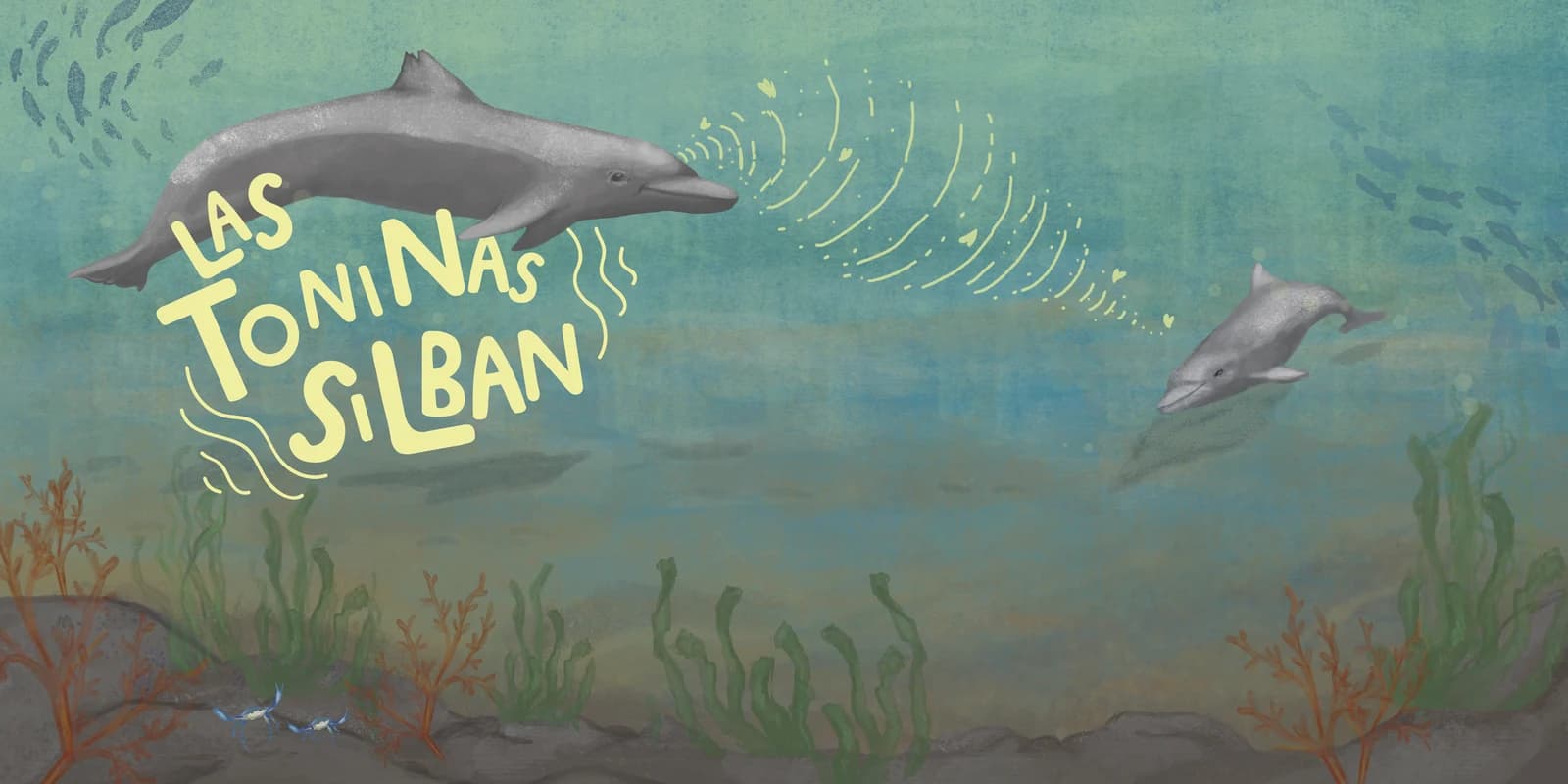
Toninas use whistles to stay in contact with their companions. Listen to a real recording made on the Rocha coast:
This illustration is from the book «El Sonido de las Toninas» →